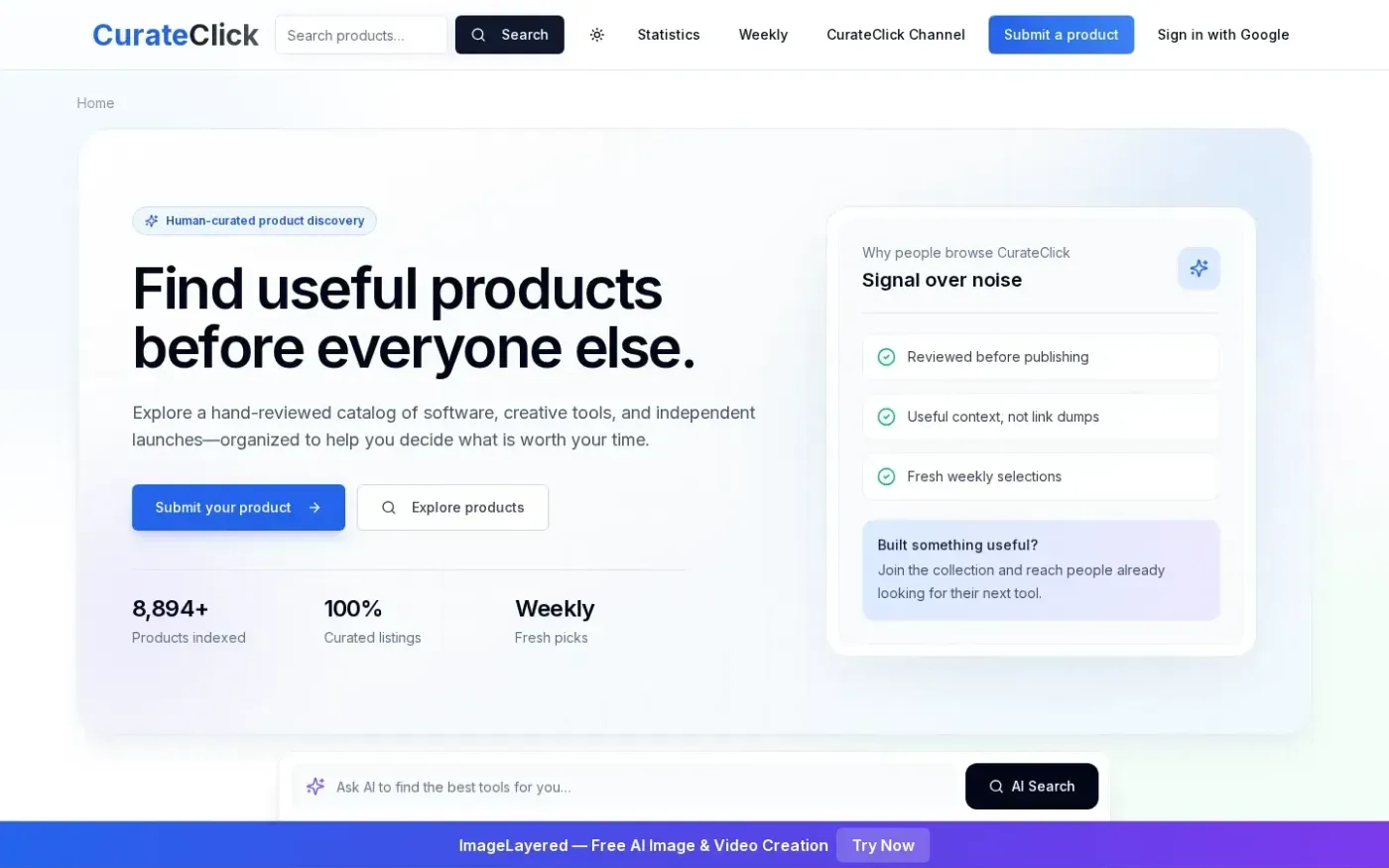
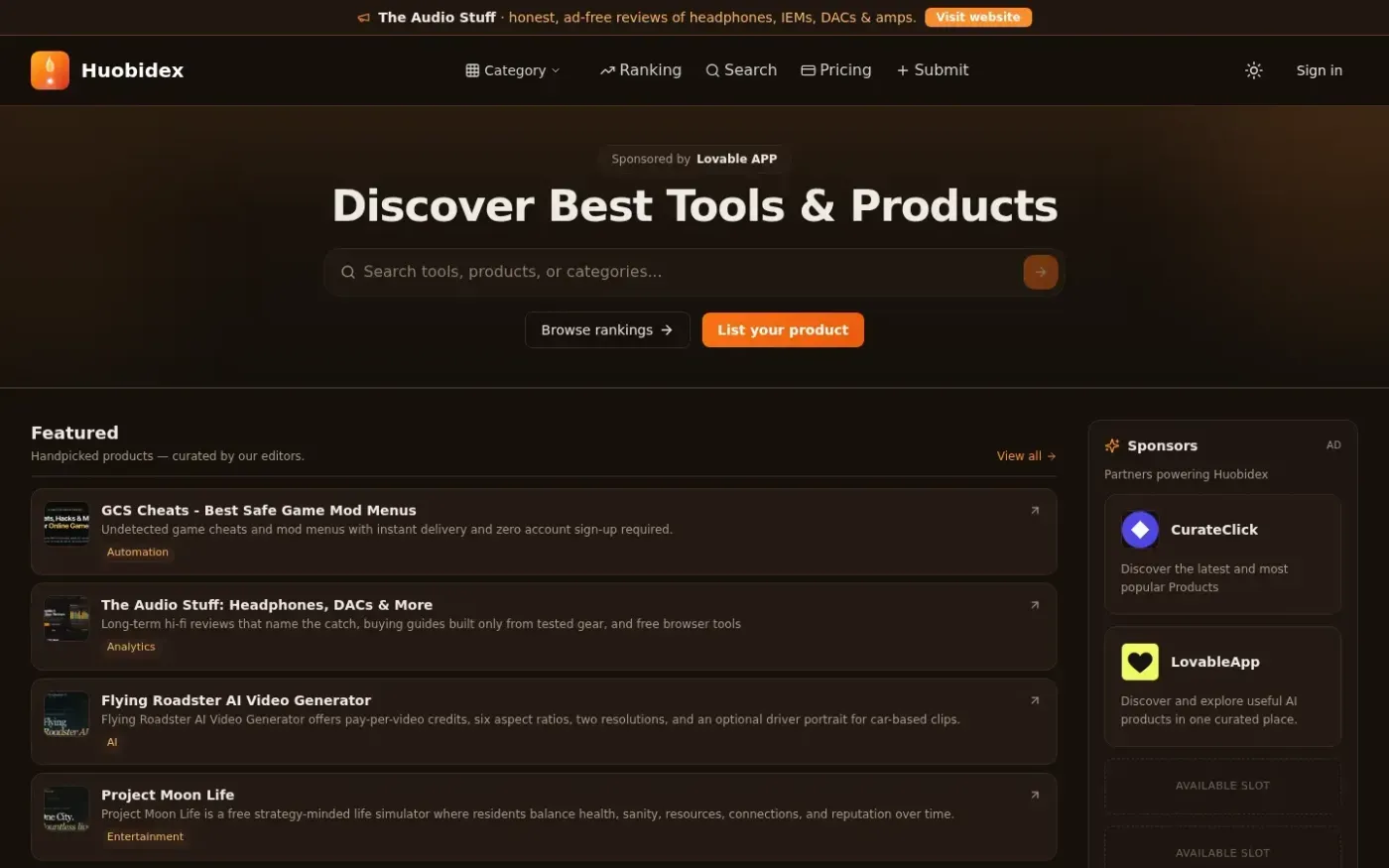
Huobidex is the stronger starting point for makers seeking inexpensive paid directory placement and clear submission instructions. Curateclick makes more sense when Weekly Picks and the article distribution advertised on its higher packages fit your launch. Neither has established referral or conversion results in our review.
Choose Huobidex for a lower-cost paid listing with clearer submission and editing instructions. Choose Curateclick when its Weekly Picks and advertised article distribution are the specific placements you want. Paying more for Curateclick is defensible for that distribution mix; our review does not establish that it delivers more prospective users.
Curateclick offers broader promotion, with an unresolved curation promise
Our review found a clear maker submission path alongside a navigable catalog and Weekly Picks. However, it also found a purchase-stage contradiction: the homepage promises review before publication, while paid packages promise immediate approval. A maker buying placement should therefore distinguish paid visibility from editorial endorsement. The public wording does not clearly reconcile those two promises. Curateclick homepage, pricing page.
Package selection also needs interpretation. Our review observed that all three paid actions use the same generic selection label. The meaningful distinction is the placement: immediate listing at entry level, Weekly Picks and advertised article distribution on Featured, and an additional seven-day bottom banner on Sponsored. Those are concrete reasons to upgrade; broad visibility claims alone do not establish the return. Curateclick pricing.
Our technical review found that both the pricing and submission pages point their canonical URL to the homepage. That raises a search-discovery concern for those maker-facing pages. It does not prove that product listings fail to appear in search, but makers should not treat a broadly crawlable catalog as proof of referral performance. Curateclick pricing.
Huobidex explains submission better, but discovery pages carry more weight
Huobidex's pricing FAQ explains Google sign-in, submission, free review timing, direct paid publication, and subsequent listing edits. That reduces uncertainty for makers who expect to maintain their listing after launch. Our review still stopped at the sign-in and submission-form boundary, so these instructions are clearer public guidance rather than confirmation that the complete transaction works. Huobidex pricing.
The public help system is less substantial than that FAQ suggests. Our review found four undated external reference cards on Resources and a notice that more resources were coming. Makers with unusual submission requirements have less self-serve guidance beyond the pricing answers. Huobidex Resources.
Huobidex also has a larger measured homepage payload: 4,226 KB across 130 requests, versus Curateclick's 1,804 KB across 165 requests. Our review found Huobidex card images delivered at dimensions far above their small display slots. This creates a particular concern for discovery on constrained mobile connections, although these measurements do not establish actual loading times or conversion losses. Both sites also had numerous undersized mobile controls. Huobidex homepage, Curateclick homepage.